


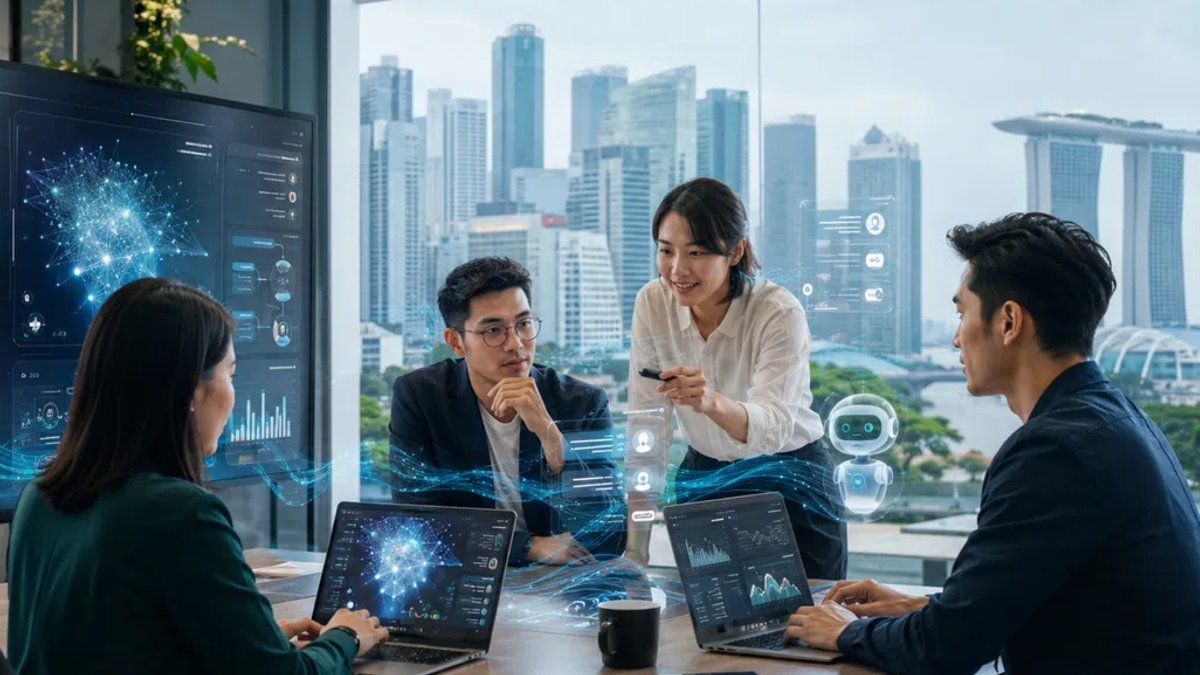
Singapore AI adoption is outpacing many regional peers, yet organizational uptake lags behind individual enthusiasm.
Workers lead the way
Microsoft’s 2026 Work Trend Index shows 63.4 percent of Singapore’s working‑age population used generative AI in the first quarter of 2026, placing the city‑state second worldwide. The International Labour Organisation’s July 2026 brief on AI and labour markets in ASEAN reports that 42.2 percent of Singapore’s total employment has at least minimal exposure to generative AI, well above the regional average of 22.9 percent.
Among those surveyed, 66 percent say they are now producing work that would have been impossible a year ago, compared with 58 percent globally. The gap widens for the most advanced users—Microsoft’s “Frontier Professionals”—where 82 percent claim they are creating output they could not have imagined before.
These workers are applying AI across a range of tasks: developers write code faster, customer‑service staff generate more personalized responses, and doctors reduce administrative burdens to spend more time with patients. Microsoft’s analysis of over 100,000 anonymised Copilot conversations found that 49 percent of interactions supported cognitive work such as analysis and problem‑solving, tasks that traditionally required specialised expertise.
Related: Samsung Galaxy Z Fold8 deal saves you over S$830
Employers lag behind
Despite strong individual uptake, only 24 percent of Singapore AI users say their leadership is clearly aligned on AI strategy, below the global benchmark of 26 percent. A further 48 percent feel it is safer to stick to existing goals rather than redesign work around AI. This mismatch, described by Microsoft as the “Transformation Paradox,” means many organisations have not yet built the processes, governance, or cultural support needed to turn personal productivity gains into broader business outcomes.
Survey results indicate that managers play a decisive role. Employees with “Frontier Professional” status report higher rates of managerial AI use (87 percent versus 72 percent for other users) and greater managerial encouragement of experimentation (81 percent versus 63 percent). Yet only 14 percent of AI users feel rewarded for reinventing their workflows, suggesting that incentives have not kept pace with the technology.
Organizational factors such as culture, manager support, and talent practices account for more than twice the reported AI impact of individual mindset and behaviour, according to Microsoft’s global findings. Without aligned leadership, the benefits of faster task completion can be lost in outdated approval processes or fragmented team structures.
Rapid diffusion of AI tools can create a paradoxical effect on skill development. While seasoned professionals may leverage AI to amplify expertise, junior staff risk bypassing hands‑on learning that builds deep judgment. This situation explains why many firms are cautious about fully automating routine tasks without preserving the apprenticeship model that traditionally cultivates expertise.
Related: Hither Green’s Delightful Discoveries: Where Love Blooms
What the shift means for the workforce
Thinking ability emerges as the most valued skill among Singapore workers, with 52 percent citing it as essential in an AI‑enabled workplace. The same survey shows 88 percent of respondents maintain responsibility for the thinking behind AI‑generated output, a figure slightly higher than the global average of 86 percent. Maintaining human oversight, according to the report, is essential for ensuring quality and accountability.
Singapore’s government is responding with targeted upskilling programs. From the second half of 2026, adults aged 25 and above who enrol in selected SkillsFuture AI courses will receive six months of free access to premium AI tools, a move announced by the Manpower Minister on 3 March 2026.
Responsible AI use also requires practical safeguards. The report recommends clear guidance on approved tools, explicit rules about data handling, and defined points for human review. Microsoft’s Responsible AI Standard provides impact assessments and content‑safety systems designed to help organisations mitigate risks without stifling experimentation.
The real test for Singapore companies will be whether they can translate high AI activity into measurable improvements in workflow design, decision‑making, and employee capability.


